


From Crime Scene to Courtroom: UNAFRI and Uganda Police Strengthen First Responder Capacity
UNAFRI Hosts Crime Scene Management Training
14 to 18 September 2026 | UNAFRI Headquarters | Naguru Kampala
More than 50 Uganda Police Force officers completed a five-day First Responder Crime Scene Management Training at the United Nations African Institute for the Prevention of Crime and the Treatment of Offenders (UNAFRI) Headquarters in Naguru, Kampala, from 14 to 18 September 2026.
Hosted by UNAFRI in collaboration with the Directorate of Forensic Services (DFS) of the Uganda Police Force, the training strengthened the knowledge and practical skills needed to secure crime scenes, preserve evidence, maintain its integrity and support scientific, evidence-led policing. Participants came from Traffic, the Field Force Unit, the Criminal Investigations Directorate (CID), the Canine Unit, Scenes of Crime, and General Duties; reflecting the range of officers who may be first to arrive at an incident.

Across the five days, one principle remained constant: the quality of justice can depend on what a first responder does, or fails to do, in the earliest moments.
Day One: The First Guardian of Evidence
The opening day established the responsibility carried by the first officer at a scene. In his opening remarks, UNAFRI Acting Director General Mr. Munanura Andrew Karokora emphasized that every crime has a crime scene and that the first officer to arrive becomes the first guardian of its evidence.
ACP Andrew Mubiru, Acting Director of Forensic Services, Uganda Police Force, stressed that effective crime scene management is a coordinated responsibility rather than the work of an individual officer. Participants were encouraged to respond methodically, preserve the scene, document their observations and work with other actors in accordance with clear procedures.
Hon. John Mulimba, Chairman of the UNAFRI Governing Board, situated the training within a wider African context. He noted that strengthening first responders in Kampala Metropolitan could help build a pool of skilled practitioners able to share experience with police services across UNAFRI’s 28 member countries, demonstrating the value of South-South cooperation.
“The scene preserved today may become the evidence that brings justice tomorrow.”

Day Two: Let the Evidence Lead the way
Day Two focused on objectivity and the disciplined handling of evidence. D/SSP Kalungi Fredrick Jonathan, Head of the Criminal Identification Department, reminded participants that accounts given at a crime scene are starting points, not conclusions. First responders must resist assumptions, preserve what they find and allow the evidence to guide the investigation.
Inspector of Police (IP) Icoot Robert, Acting Head of Scenes of Crime, reinforced the importance of properly securing, preserving and documenting a scene. The sessions examined how contamination, loss, weak documentation or poor coordination can reduce the evidential value of material before specialist personnel arrive.
Participants also considered crime scene management as a team process linking first responders, investigators, forensic personnel and other justice actors. Every observation, record and transfer of an exhibit contributes to the reliability of the eventual case.
Day Three: Connecting Investigation Prosecution and Victim Protection
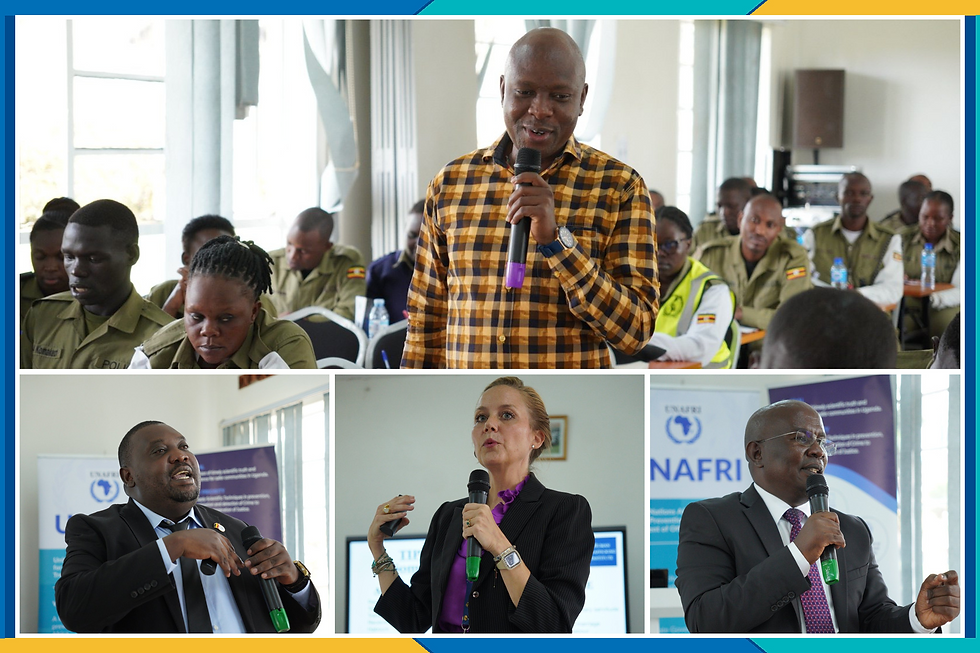
The third day broadened the discussion from the scene itself to the wider criminal justice process. ACP Odong Mark Paul, Deputy Director CID Economic Fraud and Anti-Corruption, addressed the significance of first responders and crime scene evidence in criminal investigations.
Alex Bagada, Assistant Director of Public Prosecutions, explored the relationship among investigators, supervisors and prosecutors. His session highlighted prosecution-led investigations, proper evidence handling and accurate case documentation as connected requirements rather than separate tasks.
Justice Lawrence Tweyanze examined preservation, chain of custody and responsible exhibit management from the court’s perspective. Participants considered how even a small gap in documentation or handling may raise doubt and weaken an otherwise strong case.
The training also addressed victim-centred response. Gabby Massey, Country Director of the Human Trafficking Institute (HTI), discussed the many forms of trafficking and exploitation and the responsibility of law enforcement officers to look beyond an apparent offence, identify potential victims, investigate appropriately, protect their safety and connect them with support services.
Day Four: Preparation and Practical Investigation Coordination
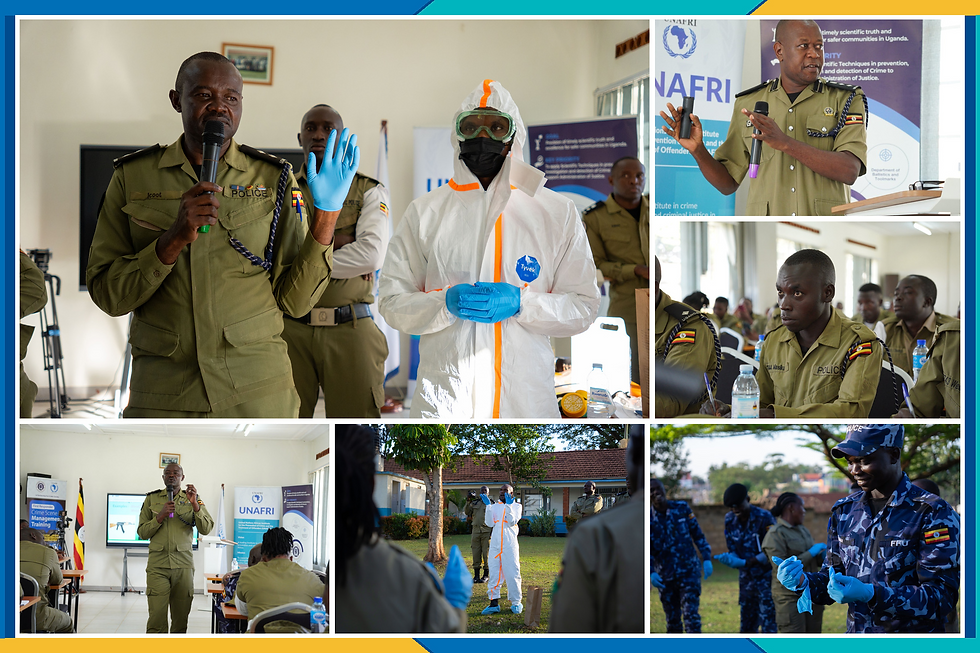
Day Four emphasized that effective crime scene management begins before an officer arrives. Participants considered the mindset, knowledge and equipment required from the moment a call is received, as well as the need to assess risks, secure the area, control access and protect evidence from contamination, weather, movement or loss.
Through group work and a preparation exercise, officers applied the principles discussed during the week. The activities reinforced communication, role clarity and coordinated decision making among personnel from different policing disciplines. The day turned procedural knowledge into a shared operational approach: prepare carefully, preserve deliberately and document accurately.

After the preparation exercise, participants moved outdoors for a practical crime scene investigation reenactment. Teams established a cordon, entered the simulated scene in protective coveralls and gloves, conducted a systematic examination around numbered evidence markers, documented observations and coordinated with a Canine team. The exercise connected scene security, contamination control, search discipline, documentation and specialist support in a realistic operational setting.

Day Five: Evidence under Courtroom Scrutiny
On the final day, the training moved from the crime scene into the courtroom. A practical court session led by Justice Lawrence Tweyanze demonstrated how evidence is presented, examined, challenged and relied upon in judicial proceedings. The exercise showed that finding evidence is only the beginning: it must also be documented, preserved, transferred and presented in a manner capable of withstanding scrutiny.

At the closing ceremony, Mr. Karokora urged participants to recognize and protect potential crime scenes from the earliest moment, without waiting for visible barriers or specialist teams. He called for the training to be progressively extended across Uganda’s 32 policing regions, with continued government and partner support.
ACP Mubiru encouraged the graduates to apply the skills in their respective units and share them with colleagues. The intention is not only to improve individual performance, but also to create multipliers who can strengthen consistent crime-scene practice across the Force.

Strengthening the Chain of Justice
The five-day programme demonstrated that crime scene management is not a single technical task. It is a chain of responsibility connecting the first officer, investigators, forensic specialists, prosecutors, courts and victim-support systems. When each link is handled professionally, evidence is more likely to retain its integrity and contribute to fair, timely and credible justice outcomes.
For UNAFRI and the Uganda Police Force, the training represents an investment in professional practice, inter-disciplinary cooperation and practical capacity that can be shared more widely. For the participants, the most important test will come beyond the classroom: at the next scene, in the decisions made during the first minutes, and in the quality of the evidence that ultimately reaches court.


Comments